Case File 08 of 10
1977-2021Where woke came fromThe words

The vocabulary now called woke came from three published sources.
Not from a committee and not from a conspiracy. It was built in the open, in statements and books still in print, by people who wrote down what they meant.
The movement's language changed, and the change is easy to misread. Race, sex and other forms of exclusion came to stand beside class. The shift can look like a retreat out of economic revolution into cultural reform. The movement's own major statements say the opposite. They present race and sex not as substitutes for anticapitalism but as new routes into it.
Black feminists argued that nobody could separate class from race or sex, because capitalism, racism and patriarchy held one another up. In 1977 the Combahee River Collective made the synthesis explicit:
"We realize that the liberation of all oppressed peoples necessitates the destruction of the political-economic systems of capitalism and imperialism as well as patriarchy."1
The same statement puts it in three words: "We are socialists."
Cedric Robinson then gave the synthesis a history. Writing in 1983, he argued that capitalism had never rationalised social relations the way Marx and Engels expected, and that the opposite had happened. "The development, organization, and expansion of capitalist society pursued essentially racial directions," he wrote, so racialism "would inevitably permeate the social structures emergent from capitalism." Then he named the result: "I have used the term 'racial capitalism' to refer to this development and to the subsequent structure as a historical agency."2
On this account capitalism does more than coexist with racism. Racial hierarchy is built into how capitalism developed, which makes fighting racism and fighting capitalism the same work rather than two causes in alliance.
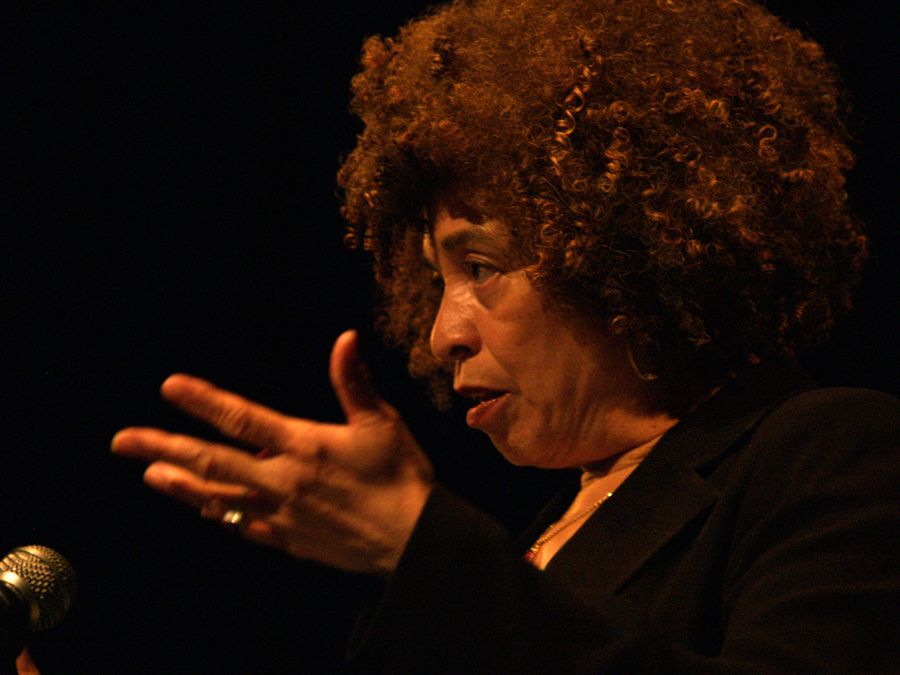
Prison abolition shows where the argument leads. For Angela Davis, prisons are not an isolated policy failure. They belong to a wider structure of racial and economic power, and pulling them down while that structure stands would remove the institution and not the thing that built it. Hence her position that it is "simply not possible to tear down prisons but leave everything else intact."3
On these terms a reform can relieve a grievance. It cannot end a struggle aimed at the order that produced the grievance.
Put the three together and you have the argument that reached the general public forty years later, and it now travels under the word woke. Race, sex and class name one structure rather than three separate complaints. The ordinary institutions of daily life keep that structure standing. Most people who hold that view today have never read Combahee or Robinson, and would be surprised to learn the argument has a bibliography.
It has one. Combahee, Robinson and Davis are the bibliography.
Sources
Every quotation was read in the document it comes from. Where editions differ, the edition consulted is named.
- Full citationCombahee River Collective, "A Black Feminist Statement," 1977. Movement source. ↩
- Black Marxism: The Making of the Black Radical TraditionUniversity of North Carolina Press, Chapel HillFull citationCedric J. Robinson, Black Marxism: The Making of the Black Radical Tradition, 1983, from the introduction. Read in the edition carrying Robin D. G. Kelley's foreword and the 2000 preface. An earlier version of this section attributed to Robinson the line that capitalism "has always been, wherever it originated, a racial system." That sentence does not appear in the book. It was replaced with what he actually wrote once the text was searched. Movement source. ↩
- Abolition. Feminism. Now.Haymarket Books, ChicagoFull citationAngela Y. Davis, Gina Dent, Erica R. Meiners and Beth E. Richie, Abolition. Feminism. Now., Haymarket Books, 2021. Movement source. ↩