Case File 09 of 10
1999-2020Autonomous zones and direct actionThe ground
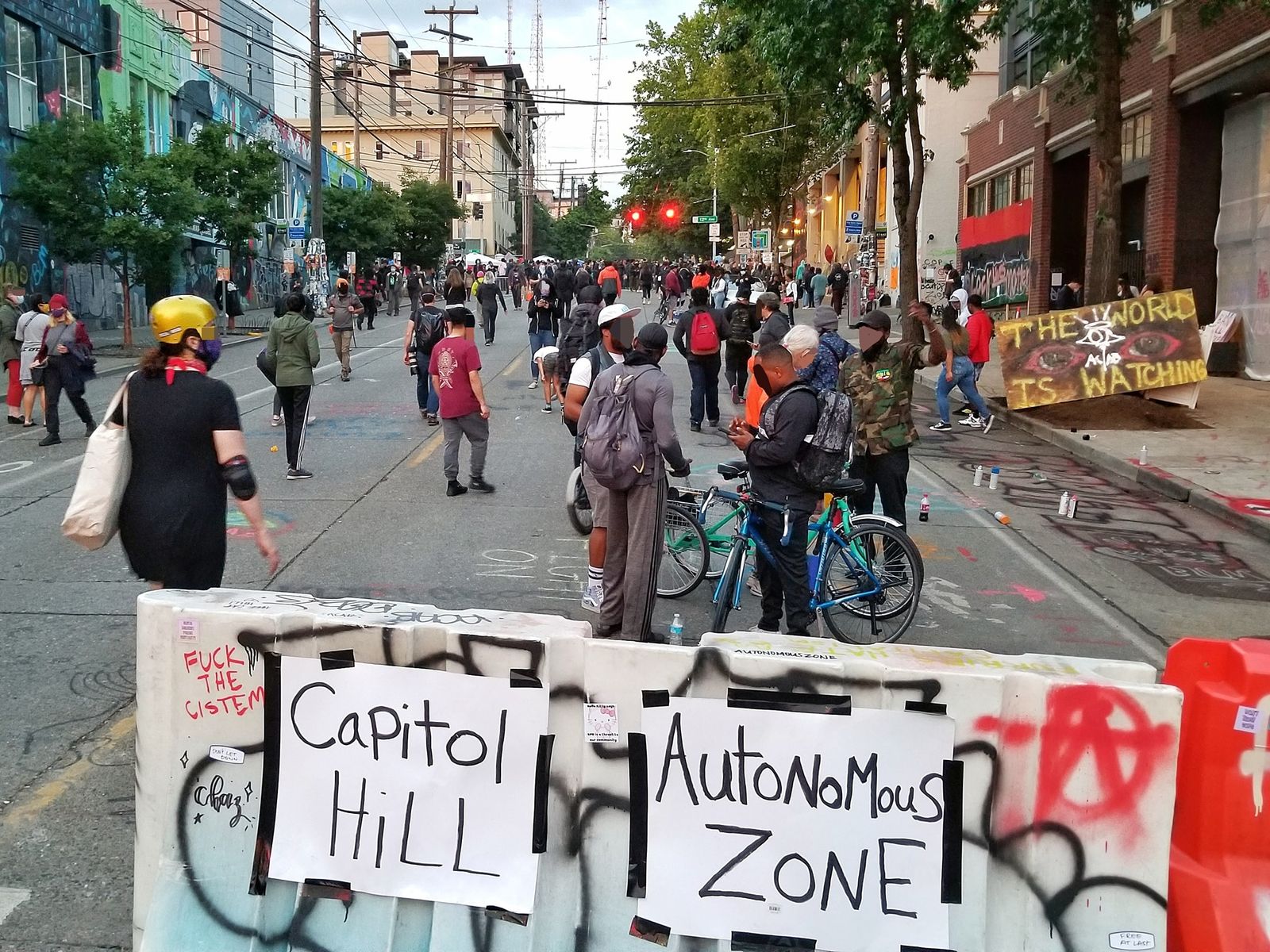

Direct action came back without a party. It came back holding ground.
In Seattle in 1999 the affinity group that broke the downtown windows set out its reasons in writing. Property destruction, they explained, is not violence, because violence has to have a living victim, and private property "is itself infinitely more violent than any action taken against it." They named the goal: "we aim to destroy the thin veneer of legitimacy that surrounds private property rights."1 They did not deny the act. They reclassified it.
Not everyone took that step. Andreas Malm refuses it, though in 2021 he made the case for sabotage against fossil infrastructure. He accepts "that property destruction is violence" and holds that "even a revolutionary Marxist should regard it as prima facie wrong."2 Malm keeps the word and makes the argument anyway.
Alongside the new definition of violence came a tactic that had a name and a theory of its own. The temporary autonomous zone, Hakim Bey wrote, is "an uprising which does not engage directly with the State, a guerrilla operation which liberates an area ... and then dissolves itself to re-form elsewhere/elsewhen, before the State can crush it."3 By 2007 the Invisible Committee had put that idea in harder terms. The question of territory, it wrote, "is not a question of occupying, but of being the territory."4
In the summer of 2020 the zone stopped being theory. Cedric Johnson writes against capitalism from inside the left. He records that activists in Seattle "took over six square blocks" including the precinct the police had abandoned to them. They declared a "police-free zone," and in Minneapolis other activists "barricaded" a neighborhood, "making the area a no-go zone for police."5
He also records that the zone "descended into lawlessness," with four shootings, two people dead, and multiple reports of rape, assault and robbery.6
Prairie Fire, the Weather Underground's own manifesto, had used the word in 1974. Bases.
Sources
Every quotation was read in the document it comes from. Where editions differ, the edition consulted is named.
- Full citationACME Collective communique on the Seattle window-breaking, quoted in Uri Gordon, Anarchy Alive!, which dates it 2000. Corroborated independently in David Graeber, Direct Action: An Ethnography, where it appears as the N30 Black Bloc communique. Movement source. ↩
- Full citationAndreas Malm, How to Blow Up a Pipeline, 2021. Cited for his refusal of the redefinition rather than for agreement with it. Movement source, cited against the surrounding argument. ↩
- Full citationHakim Bey on the temporary autonomous zone, quoted identically in two independent surveys: Peter Marshall, Demanding the Impossible, and Giorel Curran, 21st Century Dissent, which cites it to Bey 2003, page 99. Bey's own text has not been consulted directly. Movement source, one step removed, corroborated. ↩
- Full citationThe Invisible Committee, The Coming Insurrection, 2007. Movement source, primary text. ↩
- Full citationCedric G. Johnson, After Black Lives Matter: Policing and Anti-Capitalist Struggle, 2023. Johnson writes as an anti-capitalist critic from within the left, which is why he is used here for the facts rather than any opponent of the movement. Movement source. ↩
- Full citationJohnson, After Black Lives Matter. Movement source, recording the outcome against the movement's own hopes for it. ↩