Case File 06 of 10
1969-2001The Weather Underground and afterThe road that kept moving
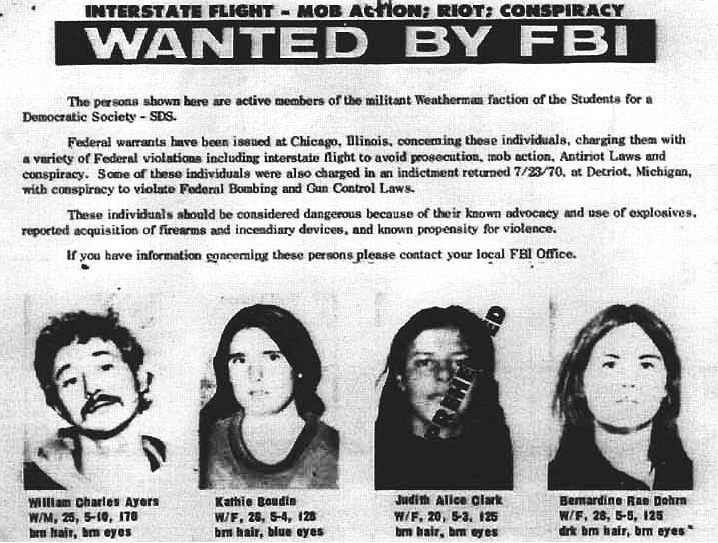

Armed struggle on the American left did not end with the Vietnam war. It ran for more than thirty years, and it changed shape about every decade.
Michael Loadenthal has traced those changes more carefully than any critic. He is a scholar who writes in defense of the militant left. In his account, "terrorism" is a word the state uses to strip its enemies of legitimacy. He is describing his own side.
The first phase was the Marxist-Leninist wave. The Weather Underground lasted from 1969 to 1977, and alongside and after it came the Black Liberation Army, the FALN, the United Freedom Front and the May 19th Communist Organization. The last of those drew on the survivors of the others. Between them they ran hundreds of bombings and armed robberies across fifteen years, and unlike what followed, they killed people. The FBI's retrospective is blunt: "From the 1960s to the 1980s, leftist-oriented extremist groups posed the most serious domestic terrorist threat to the United States."1
Patient law enforcement ended that phase, not defeat in the field. Loadenthal marks the handoff himself:
"As the Marxist-Leninist cadres were declining and their campaign of bombings and armored car robberies ending, militant struggle among leftists took a decidedly distinct turn as networks formed in defense of animal lives and the environment."2
Those networks were the second phase, and they filled the 1990s. Earth First! had published Ecodefense: A Field Guide to Monkeywrenching in 1987, a manual for disabling machinery and spiking trees. By 1996 the Earth Liberation Front had emerged. Its own press officer, Craig Rosebraugh, said it combined Earth First! sabotage with Animal Liberation Front arson into "its own brand of guerrilla sabotage, embodying the most costly spree in American history."3 Loadenthal counts at least 2,900 actions in the United States between 1979 and 2010, targeting federal agencies among others.4 Those actions killed nobody, a point Loadenthal stresses.
Loadenthal marks the third handoff too:
"The late 1990s saw the decline of aggressive animal liberation and eco-justice direct actions movements ... but this militant vacuum was soon filled ... with the rise of the so-called anti-globalization movement."5
That movement's name concealed what it was. Cindy Milstein, writing for an anarchist press, explained afterward that anarchists "haven't been afraid to name the concrete reality masked by the term globalization: that is, capitalist society."6 Five months before Seattle the same networks ran an international day of action under a banner that said it outright: against capitalism.
The Seattle protests did not defeat the World Trade Organization. They produced a template and a permission. Milstein put it the same way: once that kind of direct action "became a benchmark," anarchists "received a tacit green light from most other activists to design similar protests."7
Activists still use that template. Autonomous affinity groups take the action, and spokescouncils coordinate between them with nobody in command. Then comes the agreement called diversity of tactics: the peaceful and the destructive do not denounce each other. Loadenthal, who supports them, describes the basic unit as "small groups of activists structurally equivalent to a protest cell," and the summit circuit as where a generation went "cross-pollinating communities along the way, while solidifying kinship networks and developing and practicing new skill sets."8 The Department of Homeland Security describes the same design from the other side: "leaderless resistance tactics including operating in small, autonomous cells or individually to elude detection and complicate law enforcement operations."9
The affinity groups share an objective and refuse a chain of command, because a chain of command is what prosecutors follow.
Then the towers fell, the political weather changed, and the summit circuit emptied out. Nothing had dissolved it. It had dispersed.
Sources
Every quotation was read in the document it comes from. Where editions differ, the edition consulted is named.
- Full citationFederal Bureau of Investigation, annual report on terrorism, 1999, quoted in Loadenthal, "Leftist Political Violence." Official record, quoted one step removed. ↩
- Full citationMichael Loadenthal, "Leftist Political Violence: From Terrorism to Social Protest," chapter 3 of Robin Maria Valeri and Kevin Borgeson, eds., Terrorism in America, Routledge, 2018. Loadenthal writes in defense of these movements and argues the terrorism label is a state instrument of delegitimisation, which is why his account of the succession is used here. Sympathetic scholarship. ↩
- Full citationCraig Rosebraugh, This Country Must Change. Rosebraugh served as press officer for the Earth Liberation Front. Movement source. ↩
- Full citationLoadenthal, "Leftist Political Violence," on ALF and ELF activity, 1979 to 2010, from his own coded incident dataset. Sympathetic scholarship. ↩
- Full citationLoadenthal, "Leftist Political Violence," on the anti-globalization movement filling the vacuum. Sympathetic scholarship. ↩
- Full citationCindy Milstein, Anarchism and Its Aspirations, AK Press. Movement source. ↩
- Full citationMilstein, Anarchism and Its Aspirations. Movement source. ↩
- Full citationLoadenthal, "Leftist Political Violence," on affinity groups and summit hopping. Sympathetic scholarship. ↩
- Full citationDepartment of Homeland Security assessment on domestic extremism, quoted in Loadenthal, "Leftist Political Violence." Official record, quoted one step removed. ↩