Case File 02 of 10
1933-1960The Frankfurt School in AmericaThe theory changes address, and the cast changes
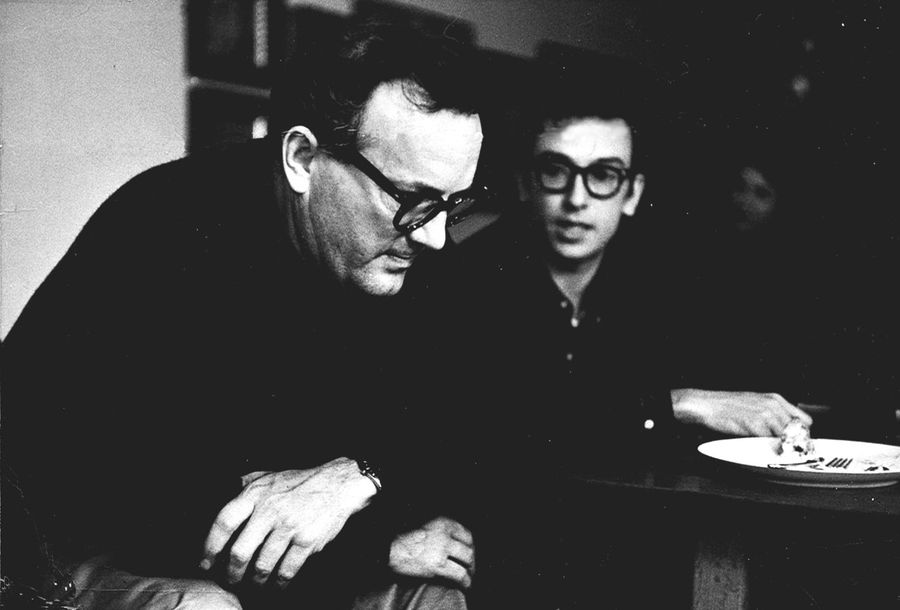

The men who built the Frankfurt Institute fled Germany, and most of them went to New York, where Columbia University gave them offices. Max Horkheimer, its director, arrived in 1934 and Herbert Marcuse reached New York the same year. Theodor Adorno joined them several years later.
They expected their stay in America to be temporary. Their influence was not. For the next twenty years, German Marxists worked in American universities and wrote about the country around them.
They were still answering the question they had brought with them: why had the workers not risen?
Horkheimer and Adorno found their answer in American mass culture. Movies, radio programs, and magazines did more than entertain. They taught people to accept society as it was, though they rarely stated the lesson outright. Happy endings, popular songs, and glossy advertisements repeated it: life was good, and only the naive imagined a different order.
A man who goes home and enjoys himself does not go looking for a revolution. In their account, that was the point.1
Horkheimer then turned the same suspicion on his own profession.
Traditional scholars said they were describing society and nothing more. Horkheimer argued that description was never neutral. A scholar chooses which questions to ask, which facts to emphasize, and which arrangements to treat as normal. When a scholar presents the existing order as natural, he helps make that order appear inevitable.
Horkheimer's argument placed professors and reporters inside politics, whether they admitted it or not. Their work could defend the existing order or expose it to challenge. Either way, they occupied no neutral seat. The university was one of the places where the fight over the existing order happened.
That argument explained why culture and education mattered, but it did not answer who would turn criticism into action. If industrial workers would not make the revolution, who would?
By 1960, the sociologist C. Wright Mills confronted that question. The European left, he argued, still assigned industrial workers a historic role that the evidence no longer supported. It clung to
"'the working class' of the advanced capitalist societies as the historic agent, or even as the most important agency in the face of the really impressive historical evidence that now stands against this expectation."2
Mills allowed that workers still mattered while denying they remained the sole or inevitable agents of political change. Once that assumption fell, the search for a new agent widened. Students, intellectuals, professionals, and excluded groups began to fill the vacancy. Massimo Teodori, chronicling the movement through its own literature, recorded the result: in every subsequent episode of political and social struggle, "the protagonists have been social groups other than 'industrial workers'."3
The battlefield widened rather than moved. The factory still counted, and the campus, the newsroom, and the profession counted now as well. The movement's social base widened with it, adding those groups alongside the workers rather than in their place. Its objective did not move at all: to end capitalist control over economic life and replace it with democratic or socialist control.
Sources
Every quotation was read in the document it comes from. Where editions differ, the edition consulted is named.
- Dialectic of EnlightenmentQuerido, AmsterdamFull citationMax Horkheimer, "Traditional and Critical Theory," in Critical Theory: Selected Essays; and Horkheimer and Theodor Adorno, Dialectic of Enlightenment, the chapter on the culture industry. Movement source. ↩
- Full citationC. Wright Mills on the agency of change, quoted in Teodori, The New Left: A Documentary History. The passage appears in Teodori's text rather than as a standalone document, and the original publication has not been consulted directly. Movement source, one step removed. ↩
- Full citationTeodori, The New Left: A Documentary History. Teodori chronicles the movement from inside its own literature. Movement source. ↩